A master built for the format
Bass, sibilance, side length: vinyl has physical constraints. They are handled upstream, for a reliable pressing.
Services · Vinyl mastering & lacquer cutting
A cutting room run by one engineer since 2004. Neumann VMS66 lathe fitted with the Flokason PITCH18 system, cutting on MDC lacquer to international standards. Lacquers cut in two to three business days and shipped to any pressing plant in the world — and you're welcome to attend the session.
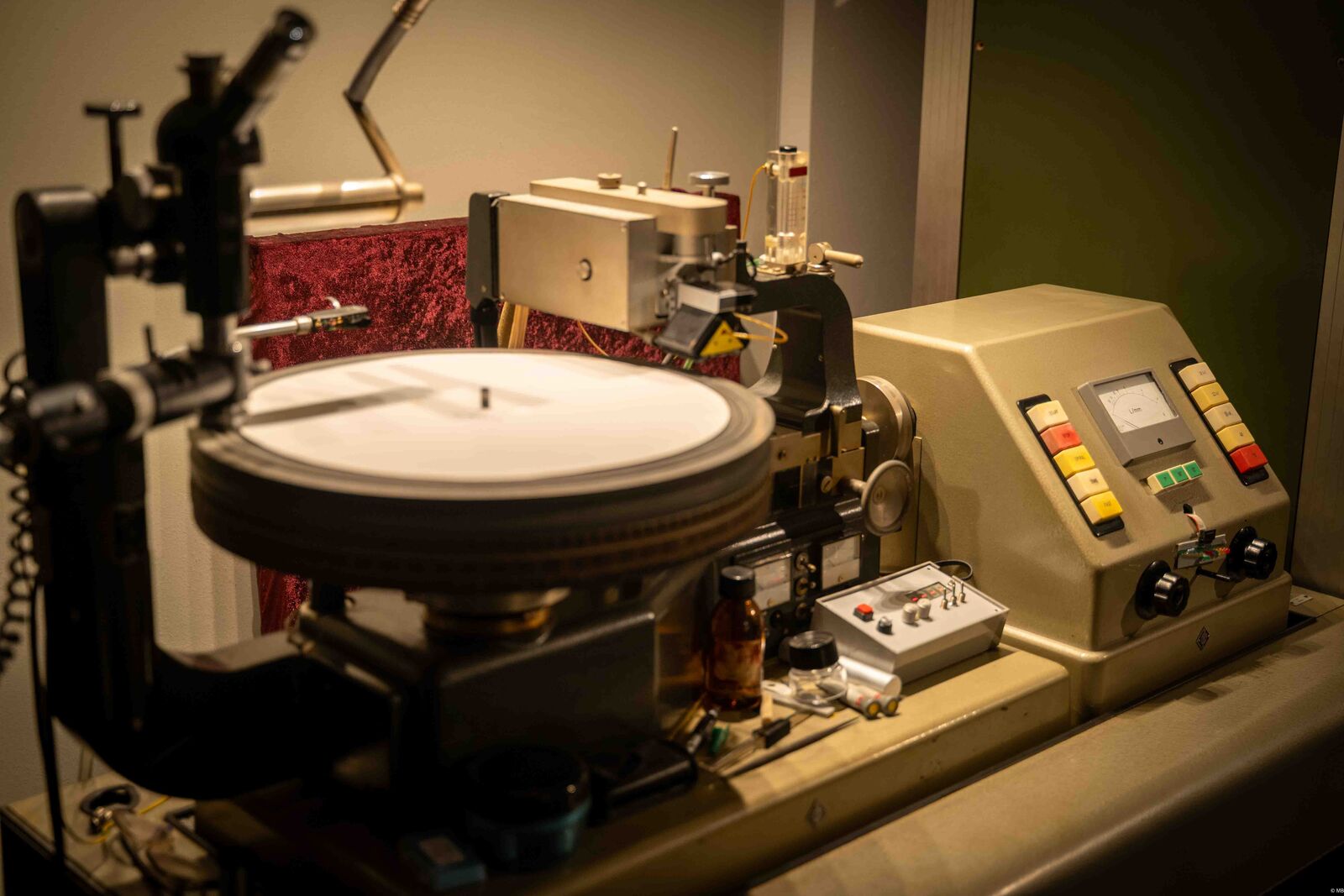 Neumann VMS66 · Flokason PITCH18
MB·MAST — 75011·A — 33⅓
Cutting sides A and B on MDC lacquer costs €320, excluding VAT. Shipping to your pressing plant is a flat €15. Dedicated vinyl mastering, cutting from tape or special requirements are quoted before any session.
Bass, sibilance, side length: vinyl has physical constraints. They are handled upstream, for a reliable pressing.
Sides A and B cut at the studio to international standards, listened to and checked at every step.
Your cut lacquers, sides A and B, checked at the studio, boxed and shipped to the pressing plant of your choice.
Fully analog cutting — from tape to lacquer, with no digital transfer — remains possible, on request.
Most of the lacquers that leave this studio don't stay in Paris. Labels in Berlin, London, Amsterdam, Tokyo or New York send their files, I cut, and the lacquers go straight to their pressing plant. There is no plant I can't ship to: I work with pressing plants all over the world, and your lacquers travel in a rigid box, tracked, for a flat €15.
The whole exchange happens in English or French, by email or WhatsApp. You send WAV or AIFF files through WeTransfer or any transfer service, I confirm what I receive, the cut is done within two to three business days, and you get the tracking number the day the lacquers leave. Invoices are in euros, from a registered French business.
Why cut in Paris rather than at the plant? Because a dedicated cutting engineer listens to your record as a record, not as one job in a queue. Side length, bass energy, sibilance, the quiet passage before the drop — these decisions are made with the music in front of me, on a lathe I have been cutting on for twenty years. Plants press what they receive; the quality of the lacquer decides the quality of the pressing.
A record is a physical object. The groove has a width, the stylus has a limit, and the inner part of the side spins past the cutter slower than the outer part. Vinyl mastering is the work of making your music fit those limits without losing what makes it yours.
Low end. Bass below roughly 100 Hz needs to be centred: wide stereo bass makes the groove move vertically and the stylus jump. This is corrected with elliptical filtering, tuned to the track rather than applied blindly.
High end and sibilance.Excess energy above 10 kHz — sharp hi-hats, harsh vocals, loud sibilants — is what the cutter head and the plant's plating struggle with. It is controlled with de-essing and gentle shaping, not by dulling the whole mix.
Level and side length. The louder you cut, the wider the groove and the less music fits on the side. Every record is a balance between level, length and inner-groove distortion; the running order and the length of each side are decided with that in mind, before the cut.
Sequencing and gaps.Track order, the silence between tracks, the lead-in and lead-out, the position of the loudest track on the side: all set at the lathe, with you if you attend, from your notes if you don't.
The lathe is a Neumann VMS66, fitted with the Flokason PITCH18 pitch and depth control system. Cuts are made on MDC lacquers. Upstream, the same mastering chain as for digital releases: Trinnov ST2-Pro monitoring, Weiss DS1-MK3, Fairman TMC, GML 9500, Manley Massive Passive, Maselec MTC-1X, and a Studer A80 for all-analog cuts from tape. I have been cutting lacquers since 2004, for several hundred artists and labels, from techno and house 12-inches to jazz and chanson albums.
Vinyl cutting is one of the services of the studio alongside stereo mastering, stem mastering and online mastering. If your record is not mastered yet, the two steps can be done together, by the same engineer, with the vinyl in mind from the start.
Two to three business days from the moment I have your approved files. Shipping to the pressing plant adds the courier time. If you already have a pressing slot, tell me the date and I plan the cut around it.
Any plant, anywhere in the world. I cut lacquers for plants across Europe, the UK, North America and Asia. Your lacquers are shipped to the plant of your choice; if you don't have one yet, I can point you to plants I know well.
A flat €15 per shipment, on top of the €320 cut. Lacquers travel in a rigid protective box, tracked.
Cutting sides A and B on MDC lacquer, the lacquers themselves, listening and inspection of the cut, labelling with your catalogue number and side identification. Shipping is €15 extra. A dedicated vinyl master, cutting from tape or special formats are quoted before the session.
Not always. Send me your files and I'll tell you. A loud, limited digital master often needs adjustments (level, low end, sibilance, stereo bass) to cut cleanly. When the digital master is already well made, I cut from it directly.
On a 12-inch at 33⅓ rpm, up to about 18–20 minutes per side keeps full level and bass; beyond 22 minutes the cut gets quieter. At 45 rpm, count about 12 minutes per side. A 7-inch at 45 rpm holds 4–5 minutes per side. Shorter sides always sound better.
7-inch, 10-inch and 12-inch lacquers, at 33⅓ or 45 rpm. Singles, EPs, albums, DJ maxis and double LPs.
WAV or AIFF, 24-bit, at the project's native sample rate, one file per track plus the running order and the gaps you want. Send them via WeTransfer or any transfer service. If you have a digital master already, send that; if not, send the mix and we discuss mastering first.
Yes. Artists and labels are welcome at the studio in Paris for the cut, by appointment. Many labels from abroad combine it with a trip to Paris.
Plating, test pressings and the pressing itself happen at the plant. I check your test pressings on request, at the studio, and tell you whether to approve them.
Describe it in a few lines — format, number of tracks, pressing plant and planned pressing date.